If your website’s only job is to confirm your business exists – a template will handle that just fine.
But if your website’s job is to generate leads, rank on Google, and grow with your business over the next three to five years – that’s a completely different conversation. And the answer to the custom vs template website debate changes entirely depending on which situation you’re actually in.
Most guides on this topic spend 800 words explaining what a template is and what a custom site means. You don’t need that. You need a straight answer based on your business, your budget, and your goals. That’s what this guide delivers.
Whether you run a medical practice in Palm Harbor, a contracting company in Clearwater, or a law firm serving the Tampa Bay area – by the end of this post, you’ll know exactly which direction fits where you are right now.
Once you know which direction fits your business, the natural next question is what it actually costs. Our detailed guide to website design pricing for your build type breaks down real local numbers for each tier – from a basic brochure site to a fully custom SEO-optimized build.
Custom vs Template Website: The Decision That Actually Matters
Before diving into pros and cons, here’s the frame that clarifies everything:
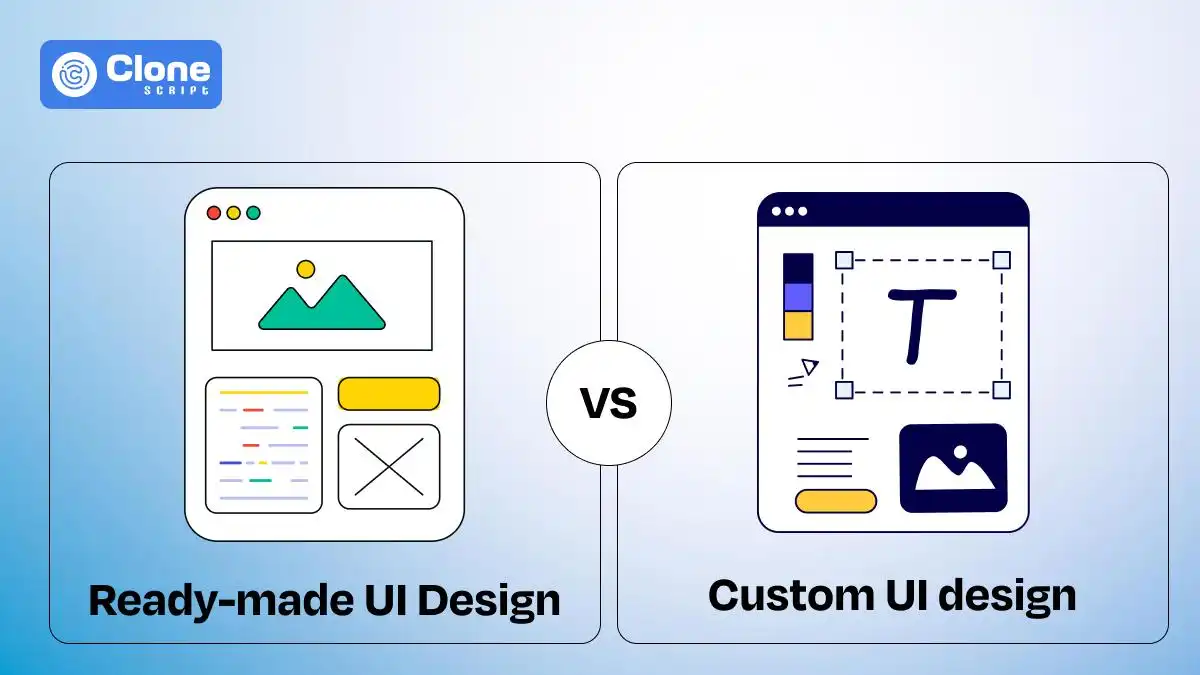
A template website uses a pre-designed layout – platforms like WordPress with a commercial theme, Squarespace, or Wix. The structure already exists. A developer customizes colors, fonts, images, and content to fit your brand, but the underlying design is shared with potentially thousands of other businesses.
A custom website is built from scratch around your specific goals. The layout, conversion flow, navigation logic, and visual language are designed for your business alone. Nothing is borrowed from a shared library.
Here’s the real distinction most agencies won’t tell you upfront: the gap between these two options isn’t just about how a site looks – it’s about what it’s designed to do. A template is built to look good for everyone. A custom site is built to convert for you specifically. That difference shows up directly in your website conversion rate over time.
If you want the full picture of what a professionally built local site includes beyond just the platform decision our custom website design guide for Palm Harbor small businesses covers everything from features and cost to mobile optimization and 2026 trends in one place.
The Case for Template Websites
Template websites get dismissed too quickly. For the right business at the right stage, they’re a smart, cost-effective decision – not a compromise.
Lower upfront cost
A professionally built WordPress or Squarespace site typically runs $1,500 to $4,000. For a business launching with a lean budget or testing a new market, that cost efficiency is real and legitimate.
Faster turnaround
Because the design framework already exists, a template site can move from kickoff to launch in two to four weeks. When timing matters – a seasonal campaign, a product launch, a rebrand under deadline – templates deliver speed that custom builds cannot.
Easier content management
Most template platforms include intuitive dashboards that let business owners update content, add pages, or publish blog posts without a developer. For small teams without a dedicated web resource, that independence has genuine operational value.
Battle-tested functionality
WordPress alone powers over 40% of all websites on the internet, according to W3Techs – which means the plugin ecosystem, third-party integrations, and developer community behind these platforms are robust and constantly maintained.
Real Scenario: A new Palm Harbor house cleaning company launching with a $2,500 budget and a six-week timeline needs something live, professional, and findable on Google. A clean WordPress build on a lightweight, mobile-first theme is exactly the right call. Get live, get leads, and revisit the platform decision in 18 months when the business has the revenue to invest in something more.
Where templates fall short: The further you want to stand out – and the more seriously you want to compete in local search – the faster templates become a ceiling. You’re sharing visual DNA with other businesses using the same theme. Your page speed and SEO flexibility are bounded by what the platform allows. And those limits become expensive when you outgrow them.
The Case for Custom Websites
Custom websites cost more and take longer. Those are genuine trade-offs, not marketing spin. But for businesses competing seriously for leads in local markets – service providers, medical practices, legal professionals, contractors across Palm Harbor and the Tampa Bay area – the strategic advantages are significant.
Built around your website conversion rate, not generic layouts
A custom site starts with one question: what do we want visitors to do? Every element – button placement, headline hierarchy, form design, page flow – gets built around that answer. Template sites optimize for visual appeal across thousands of use cases. Custom sites optimize for your specific conversion goal.
Full SEO and technical control
Custom builds give developers complete ownership of site architecture, code cleanliness, Core Web Vitals performance, and schema markup. Template platforms introduce code bloat that caps your page speed and limits how deeply you can optimize. In competitive local markets, that technical gap shows up directly in your search rankings.
Once the platform decision is made, the next step is knowing what to build into it. Our guide to the website features to prioritize after choosing your platform gives you a practical list of the ten highest-impact elements – with specific placement guidance for each one.
Bespoke website design that reflects your brand
Your business doesn’t look like everyone else’s. A custom site reflects that – original layouts, distinct visual language, interactions designed around your specific audience. When a Tampa Bay homeowner is comparing two medical spas online, a professionally distinctive website sends a credibility signal that no shared template can replicate.
Scales without hitting walls
As you add service lines, expand into new locations, build out a client portal, or create dedicated landing page designs for paid campaigns – a custom site grows without platform restrictions. Template sites frequently require a full rebuild when your needs outpace what the platform allows.
Real Scenario: A Clearwater medical spa with five treatment categories, an online booking system, and a goal of ranking for 15 local search terms chose a template site at launch to save money. Eighteen months later, the site was slow, the theme was creating plugin conflicts, and the template’s rigid layout couldn’t accommodate their booking integration. The rebuild cost more than a custom site would have from the start. This is not an edge case – it’s a pattern.
The honest trade-off: Custom builds typically start at $4,000 and run to $15,000 or more depending on complexity. They take six to twelve weeks to complete properly. If your budget or timeline genuinely can’t support that right now, a well-built template site beats a rushed custom build every time.